

Home Cell Phone Signal Booster for Trucks, Buses, Taxis & Filling Stations
South Africa • Cellular connectivity
Cell Phone Signal Booster for Trucks, Buses, Taxis & Filling Stations
Reliable mobile voice and data connectivity matters wherever people travel, work, refuel or stop overnight. A correctly selected vehicle cell phone signal booster can improve usable cellular coverage inside trucks, buses, taxis and other vehicles when compatible network signal is available outside the vehicle.
Practical guide for transport operators, fleet owners, truck stops and filling-station businesses.

Table of Contents
Why mobile signal matters on the road
Good mobile phone signal is now an important part of everyday travel and business. Dead spots are more common than many users realise, and reception can vary between mobile network operators and locations.
The source material for this article highlights several reasons why a previously usable signal can become unreliable: new buildings, growing trees, changes to base-station antenna direction, differences in network coverage and incorrect phone settings. It also notes that coverage can change quickly when a vehicle leaves a main highway and turns onto a farm road or another secondary route.
Important: A signal booster does not create a cellular network where none exists. It needs usable signal to receive from a compatible network and then improve coverage inside the vehicle or premises.
For transport businesses, the problem is not limited to making a phone call. Mobile connectivity can support communication with drivers, passengers, dispatchers and family members, while data connectivity can support messaging, navigation, online services and mobile applications.
Quick answer
Best use case: vehicles or roadside facilities where cellular signal exists outside but is weak or unreliable inside the vehicle/building.
Core system: external antenna → booster → internal antenna.
Key check: supported frequencies and South African equipment authorisation.
Cell phone signal boosters for filling stations
Modern filling stations are no longer simply places to refuel. Customers may spend time in shops, restaurants, seating areas and parking areas. Staff also rely on mobile connectivity and handheld point-of-sale systems.

Example map supplied with the source article showing filling-station locations around Gauteng.
The supplied article specifically points out that attention is often focused on indoor retail areas while parking and outdoor recreation areas receive less consideration. Improving mobile coverage in the areas where customers actually spend time can therefore form part of a broader customer-experience strategy.
Indoor connectivity
Support mobile voice and data use inside shops, restaurants and customer areas where building materials or location reduce cellular reception.
Forecourt connectivity
Consider parking, outdoor seating and other customer areas where people may need mobile service while stopping at the station.

Modern refuelling facilities increasingly combine fuel, retail, food and customer services.
The supplied source also describes the growth of destination-style forecourts, using The Pantry at a Sasol service station in Rosebank as an example of how fuel stops can combine refuelling with retail and restaurant experiences.
Cell phone signal boosters for truck stops
Truck stops along major highways provide fuel, parking, food, convenience services and overnight facilities for professional drivers. Drivers may need to call family, use mobile applications, communicate with their employers and make payments while stopped.
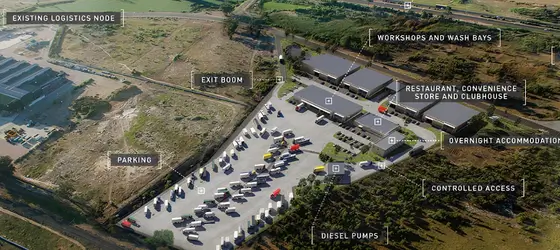
Truck-stop environments can contain large parking areas and multiple customer facilities.
Because a truck stop can cover a large outdoor area as well as buildings, the correct solution may be different from a booster designed only for a small office or vehicle cabin. Site layout, available outside signal, antenna placement and the required coverage area should be considered before selecting equipment.
Cell phone signal boosters for taxis
Minibus taxis are a major part of daily passenger transport in South Africa. The supplied article highlights journeys of around 45 minutes to an hour and notes the potential value of offering cellular signal and data connectivity as an additional passenger service.
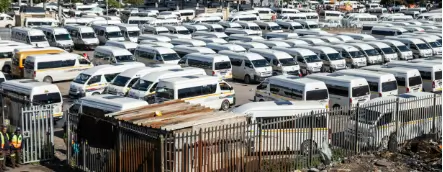
Minibus taxi transport is an important part of daily commuting.
For operators, reliable mobile connectivity can also help drivers and passengers remain connected during journeys. Any installation should be designed around the vehicle type, antenna position, power system and cellular bands required.
Cell phone signal boosters for buses and coaches
The same principle applies to public bus services, long-distance coaches and luxury tour buses. Passengers increasingly expect voice and data connectivity while travelling, particularly on longer journeys.


The source article notes that luxury bus services increasingly use streaming services and that vehicles may leave main roads for sightseeing, lodges and other destinations. Cellular connectivity can therefore provide useful communication and data access away from the main route when compatible network signal remains available.
Example map supplied with the source article showing filling-station locations around Gauteng.
Cell phone signal boosters for trucks and long-distance transport
Truck drivers spend long periods away from home and travel through changing network conditions. A vehicle signal booster can be useful when the vehicle body, terrain or location makes the mobile signal inside the cab weaker than the signal available outside.

Example map supplied with the source article showing filling-station locations around Gauteng.
The supplied article also discusses the evolution from traditional trucker radio communication towards mobile applications and push-to-talk services. Where cellular coverage is available, applications that rely on mobile data can provide another communication option for drivers and transport teams.

How does a vehicle cell phone signal booster work?
A vehicle cellular booster normally consists of three key elements:
- External antenna: mounted on or outside the vehicle to receive available cellular signal.
- Booster/amplifier: processes and amplifies the cellular signal.
- Internal antenna: rebroadcasts the improved signal inside the vehicle cabin.
The system also works in the opposite direction: the phone communicates with the internal antenna and booster, which sends the signal back through the external antenna towards the mobile network.
Outside
Receive available cellular signal
Amplify
Boost the compatible cellular signal
Inside
Provide improved in-cabin coverage
This architecture is why antenna placement matters. A booster cannot compensate indefinitely for an absent or unusable source signal, and a poorly designed installation can reduce the effectiveness of the system.
Amplitec A23 vehicle cell phone signal booster
The supplied article identifies the Amplitec A23 Four Band Cell Phone Signal Booster for Vehicles as a solution for vehicle applications. The source specifies quad-band support across 2G, 3G, 4G and 5G, 55 dB gain and 23 dBm output power.

| Application | Cars, trucks, buses and other suitable vehicles |
|---|---|
| Cellular generations | 2G / 3G / 4G / 5G family support; exact bands depend on model |
| Gain | 55 dB stated in the supplied article |
| Output power | 23 dBm stated in the supplied article |
| Power | 12V vehicle supply; suitable step-down conversion for higher-voltage vehicle systems |

Amplitec A23 series
Vehicle-oriented cellular signal booster designed for use where compatible mobile network signal is available outside the vehicle.
- 2G, 3G, 4G and 5G support across the A23 family, depending on model and supported bands.
- 55 dB gain / 23 dBm output are specified in the supplied article.
- Industrial-grade electronic components for demanding vehicle environments.
- 12V vehicle power supply.
- Suitable power conversion can be used for 24V and 48V vehicle systems.
- Aluminium alloy casing for heat dissipation.
- Compact design intended for vehicle installation.
How to choose the right cell phone signal booster
The best booster is not simply the one with the highest advertised gain. For a truck, bus, taxi, filling station or truck stop, the system should be selected around the actual network environment and the required coverage.
1. Identify the mobile networks you need to support
Check which mobile operators are used by your drivers, staff or customers and which cellular bands are available at the operating locations. Multi-band equipment can be useful when multiple networks or bands need to be supported.
2. Measure the signal outside the vehicle or building
A booster needs an input signal. If the outside signal is extremely weak or absent, changing the antenna type or installation position may be more important than simply choosing a higher-power amplifier.
3. Match the power system
Vehicle electrical systems differ. The A23 information supplied with this article specifies a 12V supply and notes that higher-voltage 24V and 48V systems can use an appropriate step-down converter.
4. Consider the physical environment
Trucks and buses operate in vibration, heat and changing weather conditions. Filling stations and truck stops have different coverage requirements because they may include large open areas, buildings and customer facilities.
5. Confirm South African equipment authorisation
ICASA states that electronic communications equipment and radio apparatus used in connection with electronic communications is subject to equipment authorisation/type approval unless an applicable exemption applies. ICASA also maintains a register of type-approved equipment.
Frequently asked questions about vehicle cell phone signal boosters
What is a cell phone signal booster for a truck?
A vehicle cell phone signal booster is a cellular repeater system designed to improve usable mobile signal inside a vehicle. It normally uses an outside antenna, an amplifier and an inside antenna.
Can a signal booster improve mobile signal in a bus or taxi?
Yes. Vehicle boosters can be designed for buses, taxis, trucks, cars, caravans and other suitable vehicles, provided compatible cellular signal is available outside the vehicle.
Will a signal booster work if there is absolutely no signal?
No. A booster amplifies an available cellular signal; it does not create a mobile network where none reaches the vehicle or site.
Does the Amplitec A23 support 5G?
The A23 series includes configurations supporting different cellular bands and the manufacturer describes the family as supporting 2G, 3G, 4G and 5G bands. The exact frequencies depend on the selected A23 model.
Can an A23 be installed in a 24V or 48V truck?
The supplied article specifies a 12V vehicle supply and states that 24V and 48V battery systems can be accommodated using a suitable step-down converter.
Are cell phone signal boosters legal in South Africa?
Equipment authorisation requirements apply to electronic communications and radio equipment in South Africa. Use equipment that is appropriately authorised for South African use and follow the applicable installation and regulatory requirements.
Cellular connectivity for transport and roadside businesses
Whether the requirement is a cell phone signal booster for a truck, a vehicle signal booster for a bus, a mobile signal booster for a taxi or improved cellular coverage at a filling station or truck stop, the starting point is the same: establish the available outside signal, identify the required networks and bands, then select the correct antenna, booster and installation.
For South African transport operators and roadside businesses, a properly designed cellular solution can help keep drivers, staff and passengers connected in places where vehicle construction, terrain or location makes mobile reception unreliable.
Need help choosing a vehicle signal booster?
System Design Experts supplies cellular signal booster equipment for South African applications. If you are fitting out a truck, bus, taxi, fleet or other vehicle, choose the booster and band configuration around your actual network requirements.
View the Amplitec A23 Vehicle Signal BoosterSystem Design Experts — Cellular signal booster solutions in South Africa.
This article is informational and does not replace a site survey, technical assessment, product datasheet or regulatory advice.
